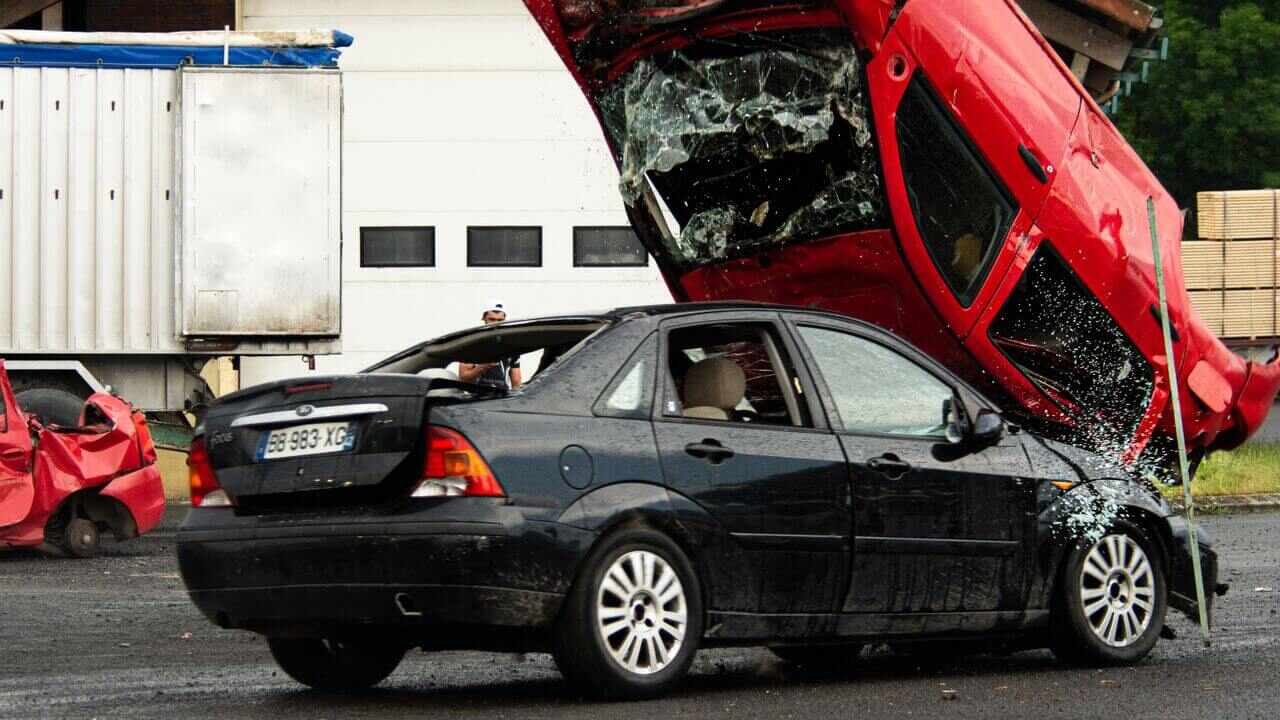
A multi-vehicle accident involves three or more vehicles, and that means a claim that is far more complex than a typical two-car accident. I’ve been fighting insurance companies since 1995, and I personally handle every file from beginning to end. If you’ve been injured in a multi-vehicle collision in Hamilton or anywhere in the Golden Horseshoe, call me for a free consultation at 905-769-0418.
What Is a Multi-Vehicle Accident? Pileups and Chain-Reaction Crashes in Hamilton
A multi-vehicle accident is any collision involving three or more vehicles. Also called a pileup, chain-reaction crash, multi-car accident, or multiple-vehicle collision, these crashes are complex because fault may be shared among several drivers, multiple insurance companies become involved, and each impact may need to be investigated separately.
In a multi-vehicle collision claim in Ontario, investigators often have to determine responsibility for each individual impact rather than treating the incident as one single collision. Consulting a Hamilton car accident lawyer after this kind of crash is important because multi-vehicle collisions often involve:
- Multiple impacts that expose your body to forces from different directions
- Several drivers, insurers, defence lawyers, and adjusters
- Conflicting witness accounts and competing versions of events
- Longer investigations before liability is determined
- Insurance policy limits that may have to be shared among several injured people
Hamilton’s location makes it particularly vulnerable to serious highway pileups. The QEW, Highway 403, the Lincoln M. Alexander Parkway (the Linc), the Red Hill Valley Parkway, and the Burlington Skyway all experience heavy traffic, especially during commuter hours.
How Many Vehicles Make it a Multi-Vehicle Accident?
Generally, any collision involving three or more vehicles is considered a multi-vehicle accident.
Why Trust Derek Wilson for Your Multi-Vehicle Accident Claim in Hamilton
A multi-vehicle accident lawyer should understand how insurance companies investigate and defend complex pileup claims. I know how those arguments are built because I began my legal career representing insurance companies before dedicating my practice exclusively to injured people.
I’ve practised personal injury and insurance litigation since 1995 and now represent injured plaintiffs throughout Hamilton and Southern Ontario. I deliberately limit my caseload so every client works directly with me. In a complex claim, having one experienced lawyer who knows every detail of your case is a practical advantage.
When you hire me:
- I work with accident reconstruction engineers, medical specialists, and other experts when needed.
- I communicate with the insurance companies so you can focus on your recovery.
- You pay no upfront legal fees.
I’m honoured to have been recognized in The Best Lawyers in Canada® (since 2021), and my firm has been recognized in Best Law Firms™ – Canada as a Regional Tier 1 firm. I am also a member of the Law Society of Ontario and the Hamilton Law Association. My office is located at 19 Bold Street, Unit 1, Hamilton, near the John Sopinka Courthouse, and I represent clients throughout the Golden Horseshoe.
If you’ve been injured in a chain-reaction collision, I’d be happy to explain your legal options during a free, no-obligation consultation. Call 905-769-0418 to speak directly with me.
Do I Have To Pay Anything Upfront To Hire a Multi-Vehicle Accident Lawyer in Hamilton?
No. I handle every multi-vehicle accident claim on a contingency fee basis. You pay no upfront legal fees and no legal fees unless I recover compensation for you.
Who Is at Fault in a Multi-Vehicle Accident in Ontario?
Fault in a multi-vehicle accident does not have to add up to 100%. In Ontario, several drivers can each be found responsible for different impacts within the same chain-reaction collision. That’s one of the biggest differences between a pileup and a typical two-car accident.
In a multi-vehicle collision claim in Ontario, there is a two-track system to determine fault and seek compensation:
Track 1 – Property Damage
For vehicle damage claims, insurers apply Ontario’s Fault Determination Rules under the Insurance Act. These rules assign fault for property damage, including Direct Compensation–Property Damage (DC-PD), and include specific provisions for chain-reaction crashes involving three or more vehicles.
Track 2 – Personal Injury Claims
A personal injury lawsuit follows different rules.
The Fault Determination Rules do not determine liability in a tort claim. Instead, the court considers negligence, reviews the evidence, and decides liability on a balance of probabilities.
Common scenarios include:
Scenario | General Principle |
Car A is stopped. Car B rear-ends Car A. Car C then rear-ends Car B. | Fault is generally assessed impact by impact. Drivers who fail to leave a safe stopping distance are usually responsible for the collision they could not avoid. |
You are struck from behind and pushed into the vehicle ahead. | You may not be at fault for the forward impact because you were propelled into the other vehicle. Every case depends on the evidence. |
Three or more vehicles collide while changing lanes. | Fault is often shared between drivers based on each person’s actions before each impact. |
A driver brakes suddenly or creates a roadway hazard before being struck. | That driver may bear partial responsibility if the manoeuvre was negligent. |
These are general legal principles, not guarantees. Every multi-car accident turns on its own facts and evidence.
Even if you’re found partly at fault, you may still recover compensation. Under Ontario’s Negligence Act, contributory negligence generally reduces your damages in proportion to your share of responsibility.
Another important concept is joint and several liability. If more than one defendant is found liable, you may generally recover the full judgment from one of them, leaving that defendant to seek contribution from the others. This becomes especially important when one driver has limited insurance coverage.
Evidence often determines how fault is ultimately apportioned, and may include police reports, camera footage, witness statements and accident reconstruction engineering evidence.
If I Was Pushed Into the Car in Front of Me, Am I at Fault?
Not necessarily. Investigators will determine whether you had any realistic opportunity to avoid the collision.
Can More Than One Driver Be at Fault in the Same Accident?
Yes. Each driver’s conduct is assessed separately based on the available evidence.
Multiple Insurers, Shared Policy Limits, and Why Pileup Claims Are Harder
One of the biggest risks after a multi-vehicle accident is whether there is enough insurance available to fully compensate everyone who was injured.
Although many Ontario drivers carry $1 million or $2 million in third-party liability coverage, the legal minimum remains $200,000. If one negligent driver causes a serious pileup involving multiple injured people, everyone may effectively be claiming against a finite pool of insurance money.
Common scenarios in a multi-vehicle collision claim in Ontario can include:
Scenario | General Principle |
Car A is stopped. Car B rear-ends Car A. Car C then rear-ends Car B. | Drivers who fail to leave a safe stopping distance are usually responsible for the collision they could not avoid. |
You are struck from behind and pushed into the vehicle ahead. | You may not be at fault for the forward impact because you were propelled into the other vehicle. Every case depends on the evidence. |
Three or more vehicles collide while changing lanes. | Fault is often shared between drivers, based on each person’s actions before impact. |
A driver brakes suddenly or creates a roadway hazard before being struck. | That driver may bear partial responsibility if the manoeuvre was negligent. |
If a transport truck was involved, additional evidence may be available, including electronic logging device (ELD) records, telematics, maintenance records, and hours-of-service documentation. Commercial trucking companies also often carry significantly higher insurance limits than private motorists. Consult with a truck accident lawyer in Hamilton to learn more.
Another challenge is time. Multi-vehicle claims usually take longer to resolve because several insurers are investigating liability and attempting to apportion fault among themselves.
Opening your accident benefits claim immediately can provide financial support while liability issues are being resolved.
What Happens if the At-Fault Driver Doesn’t Have Enough Insurance?
Depending on the circumstances, compensation may be available through Statutory Accident Benefits, an OPCF 44R Family Protection Endorsement, uninsured or unidentified motorist coverage, joint and several liability, or additional defendants with available insurance.
Compensation After a Multi-Vehicle Accident in Ontario
After a multi-vehicle accident in Ontario, you may have two separate claims: a Statutory Accident Benefits claim through your own insurer and a personal injury lawsuit against one or more at-fault drivers. Each serves a different purpose and follows different legal rules.
Statutory Accident Benefits (SABS)
Statutory Accident Benefits are available regardless of who caused the collision. These benefits may include:
- Medical and rehabilitation expenses
- Income replacement benefits
- Attendant care benefits
- Caregiver benefits (where applicable)
- Housekeeping and home maintenance benefits in qualifying cases
- Increased benefits for catastrophic impairments
To start your claim, you’ll generally need to submit an OCF-1 Application for Accident Benefits. Because notice and application deadlines are short, apply promptly. If disputes arise, they are generally heard by the Licence Appeal Tribunal (LAT).
Your Personal Injury Lawsuit
A lawsuit against one or more negligent drivers may allow you to recover compensation for:
- Pain and suffering
- Past and future income loss
- Loss of earning capacity
- Future medical treatment and care
- Out-of-pocket expenses
- Family Law Act claims for eligible family members
Ontario’s Insurance Act requires a permanent serious impairment before pain-and-suffering damages can be recovered. Even when that threshold is met, a statutory deductible may apply.
As of 2026, the deductible for non-pecuniary damages is $47,913.01. The deductible no longer applies where the award exceeds $159,708.71, with both figures indexed annually by the Financial Services Regulatory Authority of Ontario (FSRA).
Important Deadlines
Protecting your rights starts immediately after the collision:
- Apply for Statutory Accident Benefits as soon as you receive the required forms; notice periods are measured in days.
- Preserve evidence quickly.
- In most cases, Ontario’s Limitations Act, 2002 provides a two-year limitation period to start a lawsuit, although exceptions can apply.
How Much is My Claim Worth?
Every case is different. The value of a claim depends on factors including the severity of injuries, fault, and the available insurance coverage.
How Long Do I Have to File a Claim After a Multi-Vehicle Accident in Ontario?
Generally, you have two years to start a personal injury lawsuit, but important deadlines arise much sooner.
Can I Still Claim Compensation If I Was Partly at Fault for the Pileup?
Yes. Under Ontario’s Negligence Act, being partly at fault usually reduces your compensation rather than preventing recovery.
What to Do After a Multi-Vehicle Accident in Hamilton
Because several drivers, insurers, and witnesses may be involved, preserving evidence as early as possible is especially important in this kind of situation:
- Get to safety. If you’re on the QEW, Highway 403, the Lincoln M. Alexander Parkway, or another high-speed roadway, secondary collisions are a real danger.
- Call 911. The Ontario Provincial Police (OPP) generally investigate collisions on provincial highways, while the Hamilton Police Service responds to crashes on city streets. Get the incident or occurrence number before leaving the scene.
- Seek medical attention. Even if you feel fine, multi-impact collisions can cause traumatic brain injuries, spinal injuries, and internal injuries that don’t appear immediately.
- Photograph everything. Capture vehicle damage, final resting positions, skid marks, debris, road and weather conditions, traffic signs, and the overall scene.
- Collect information from every driver you can. Gathering names, licence plates, and insurance information from all involved vehicles can be extremely important.
- Get contact information for independent witnesses. Neutral witnesses are important because drivers in the crash may be protecting their own best interests.
- Don’t admit fault or speculate. Simply provide the facts.
- Report the collision to your own insurer. Open your Statutory Accident Benefits claim as soon as possible.
- Consult with a lawyer early. Consulting with a lawyer before speaking with insurers can help protect your claim.
Acting quickly and strategically supports a strong case.
Should I Give a Statement to the Other Drivers’ Insurance Companies?
Not before you understand your rights. Before providing a recorded statement, it’s often wise to obtain legal advice.
Speak With Hamilton Multi-Vehicle Accident Lawyer Derek Wilson
Since 1995, I’ve represented people injured in multi-vehicle accidents throughout Southern Ontario.
I offer:
- Free, no-obligation consultations
- No legal fees unless I recover compensation for you
- Direct access to me throughout your case
- Decades of experience handling complex personal injury claims
I proudly represent clients throughout Hamilton, Stoney Creek, Ancaster, Dundas, Burlington, Brantford, Cambridge, Grimsby, Oakville, Milton, St. Catharines, Niagara Falls, Welland, Guelph, Kitchener, Waterloo, and communities across the Golden Horseshoe. My office is located at 19 Bold Street, Unit 1.
If you’re looking for an experienced Personal Injury Lawyer in Hamilton who personally handles every file, contact my office or call me at 905-769-0418.
I get results. Period.