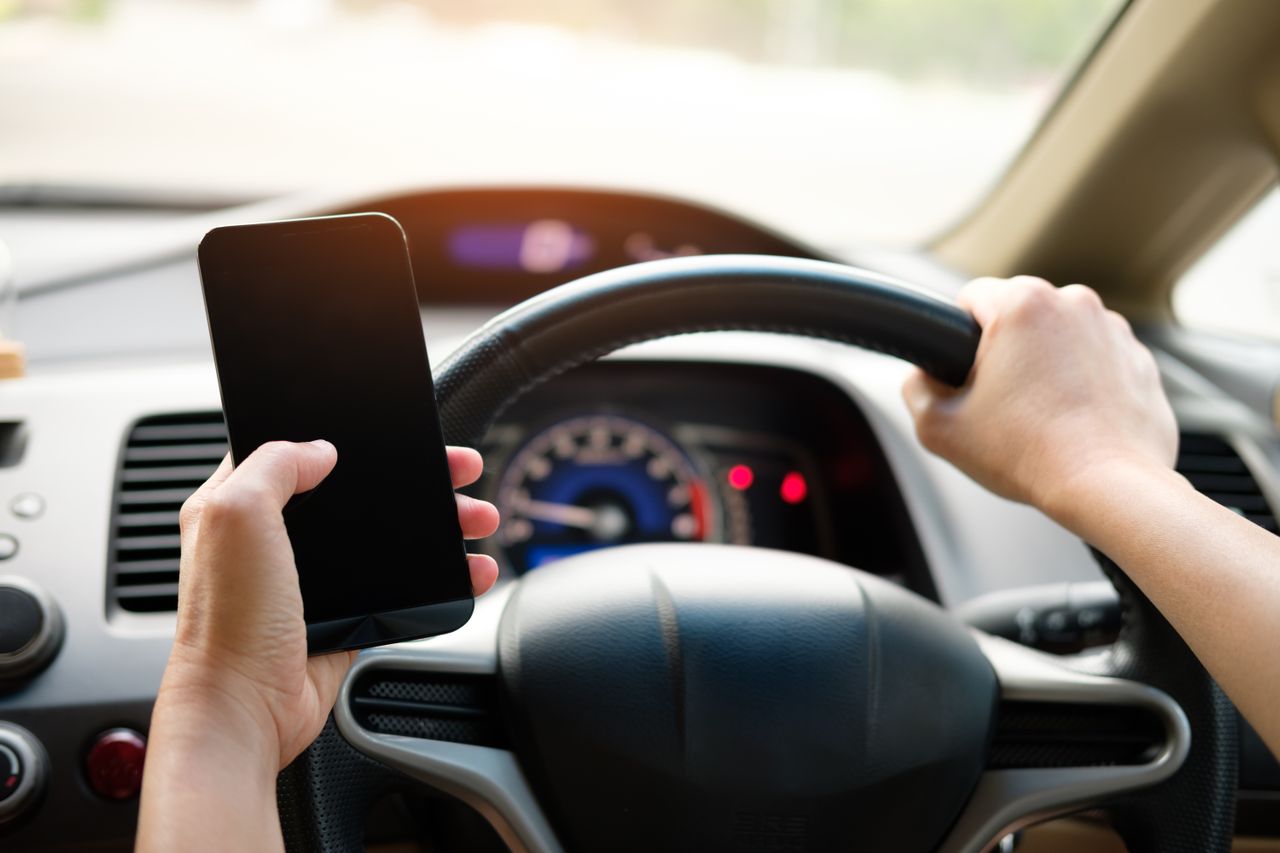
Distracted driving is a leading cause of serious collisions on Ontario roads. If you were injured by a driver who was not paying attention, you may be entitled to compensation, even if the police never laid a distracted driving charge. I’ve been fighting insurance companies since 1995, and I personally handle every distracted driving case from beginning to end. Call me today for a free consultation at 905-769-0418.
What Counts as Distracted Driving in Ontario?
Under Ontario’s Highway Traffic Act, the specific distracted driving offence found in section 78.1 applies primarily to holding or using a hand-held wireless communication device. But in a civil injury claim, a driver can be negligent for distractions that never result in a distracted driving ticket. Illegal and negligent are not the same thing.
The Highway Traffic Act specifically prohibits:
- Holding or using a hand-held cellphone or other wireless communication device, even while stopped at a red light.
- Viewing display screens unrelated to the driving task.
- Programming a GPS or navigation device by hand while the vehicle is moving.
- Physically holding a phone, even briefly. A driver can be charged simply for picking up a phone to check the time. Active texting or calling is not required.
Many dangerous distractions, however, are not specifically prohibited under section 78.1 but may still establish negligence in a personal injury lawsuit, including:
- Eating or drinking while driving.
- Reaching into the back seat or onto the floor.
- Grooming or attending to children or pets.
- Adjusting the radio, climate controls, or infotainment system.
- Using a hands-free phone while becoming mentally distracted from driving.
- Fatigue or “mind-off-road” inattention that prevents a driver from recognizing hazards.
Where distraction causes a collision resulting in injuries, police often lay broader charges instead of a section 78.1 offence. These can include careless driving under section 130 of the Highway Traffic Act, careless driving causing bodily harm or death under section 130(3), or, in the most serious cases, dangerous operation of a conveyance under section 320.13 of the Criminal Code.
In Hamilton, many serious crashes occur at intersections and along busy corridors such as Main Street, King Street, Upper James Street, Mohawk Road, Barton Street, Highway 403, the QEW, the Lincoln M. Alexander Parkway, and the Red Hill Valley Parkway. Distracted driving is only one cause of a collision, but it has become an increasingly common one for anyone seeking the assistance of a Hamilton car accident lawyer.
Is Hands-Free Phone Use Still Distracted Driving in Ontario?
Not under section 78.1 of the Highway Traffic Act. Properly used hands-free devices are generally legal, but a driver who becomes cognitively distracted can still be found negligent.
Why Trust Derek Wilson for Your Distracted Driving Accident Claim in Hamilton
The insurance company’s first response in many distracted driving cases to deny the driver was distracted, point out that no distracted driving charge was laid, and argue there is no proof that a cellphone played any role in the collision. I know exactly how those arguments are built because I began my career representing insurance companies before dedicating my practice exclusively to helping injured people.
That experience matters in distracted driving cases because these claims often succeed or fail on evidence, such as cell phone records that must be preserved quickly.
When you hire me, you hire me and not a junior associate or a revolving team of lawyers. I deliberately maintain a manageable caseload so I can personally oversee distracted driving cases.
I’ve been practising personal injury and insurance litigation since 1995 and now act exclusively for injured plaintiffs. I work on a contingency fee basis, so you pay no legal fees unless I recover compensation for you, and there are no upfront legal costs to begin your claim.
My professional recognitions include:
- The Best Lawyers in Canada
- Best Law Firms – Regional Tier 1
- Member of the Law Society of Ontario
- Member of the Hamilton Law Association
My office is conveniently located at 19 Bold Street, Unit 1, Hamilton, minutes from the John Sopinka Courthouse. I proudly represent clients throughout Hamilton, Stoney Creek, Ancaster, Dundas, Burlington, Grimsby, Brantford, Cambridge, and communities across the Golden Horseshoe.
If you believe a distracted driver caused your injuries, I invite you to contact me for a free consultation. I’ll personally review your case and answer your questions honestly. Call 905-769-0418 to get started.
Do I Have To Pay Anything Upfront To Hire a Distracted Driving Accident Lawyer in Hamilton?
No. I handle distracted driving injury claims on a contingency fee basis.
How Do You Prove the Other Driver Was Distracted?
These cases are won by preserving records and data that show what the driver was doing in the moments before impact, and much of that evidence has a very short lifespan.
Evidence Type | What It Shows | Why Timing Matters |
Cell phone records | Call, text, and data activity timestamped against the time of the collision | Carriers retain detailed records for limited periods. Obtaining them generally requires a formal legal request or court order. |
The phone itself | App usage, screen activity, messages sent or read | The device must be preserved before data is lost, replaced, or overwritten. |
Dash-cam footage | The driver’s head position, phone in hand, lane drift, or lack of attention before impact | Most systems record on a loop and automatically overwrite footage within days. |
Nearby cameras | Red-light cameras, business CCTV, transit cameras, and traffic cameras | Video is often deleted within weeks unless someone requests that it be preserved. |
Event Data Recorder (EDR) | Speed, braking, steering, throttle input, and vehicle movement in the seconds before impact | The vehicle must be inspected before repairs, salvage, or destruction. |
Police collision report and Crown disclosure | Officer observations, witness statements, admissions, and any charges laid | Helpful evidence, but a charge is not required to prove negligence. |
Independent witnesses | What bystanders actually saw the driver doing | Memories fade quickly and witnesses become difficult to locate. |
Accident reconstruction | Reaction time, sightlines, visibility, and perception-response analysis | Best completed while the physical evidence remains available. |
One of the strongest pieces of evidence in many distracted driving cases is the vehicle’s Event Data Recorder, commonly called the “black box.” If that data shows the vehicle travelled at full speed into stopped traffic without any meaningful braking, it can suggest the driver never saw the hazard because their attention was somewhere else.
Another important step is sending a preservation letter. I can send formal notice requiring the other driver, their insurer, and, where appropriate, a commercial vehicle operator to preserve phone records and other evidence before it can be destroyed.
If you’re still at the collision scene, make your own notes while everything is fresh. Record whether you saw a phone in the driver’s hand, where the driver’s eyes were looking, whether they appeared to brake, and what independent witnesses observed. Those small details often become important months later when memories have faded.
Can I Get the Other Driver’s Cell Phone Records After a Crash?
Sometimes, yes, they may be obtained through the legal process.
Does a Distracted Driving Ticket Mean the Other Driver Is Automatically Liable?
No. A distracted driving conviction under the Highway Traffic Act does not automatically decide your civil injury claim. At the same time, the absence of a distracted driving charge does not mean you have no case. Both points are important.
A distracted driving collision often involves two completely different legal proceedings.
The Provincial or Criminal Proceeding
If police lay charges under the Highway Traffic Act or the Criminal Code, those proceedings are prosecuted by the Crown. Their purpose is to determine whether the driver committed an offence and, if so, what penalty should be imposed.
As of 2026, a first distracted driving conviction for a fully licensed driver generally starts with a fine of approximately $615, three demerit points, and a three-day licence suspension, with escalating consequences for repeat offences.
Those penalties punish the driver. They do not compensate the injured victim. Compensation comes only through accident benefits and, where appropriate, a civil injury claim.
Your Civil Injury Claim
Your personal injury claim is separate. It focuses on whether another person’s negligence caused your injuries and financial losses. That case is built through evidence gathered by your lawyer, not by the police investigation alone.
A distracted driving conviction can support the negligence narrative, may provide access to Crown disclosure such as officer notes and witness statements, and often makes it more difficult for an insurer to deny liability. It is not automatic proof.
What If the Police Didn’t Charge the Driver Who Hit Me?
You may still have a strong claim. Your case is determined by all of the available evidence, not simply whether a ticket was issued.
Compensation After a Distracted Driving Crash in Ontario
After a distracted driving collision, you may have two separate claims: a claim for statutory accident benefits through your own automobile insurer and a civil claim against the at-fault driver. As of July 2026, the accident benefits available under Ontario policies have changed significantly, making it more important than ever to understand your coverage.
Statutory Accident Benefits
Following the changes introduced through O. Reg. 383/24, only certain benefits remain mandatory under every automobile policy.
Mandatory benefits include:
- Medical benefits
- Rehabilitation benefits
- Attendant care benefits
Optional benefits include:
- Income replacement benefits
- Non-earner benefits
- Caregiver benefits
- Housekeeping and home maintenance benefits
- Death and funeral benefits
- Visitor expenses
Eligibility for these optional benefits is also narrower than before. This can mean that a pedestrian or cyclist injured by a distracted driver may still receive mandatory medical and rehabilitation benefits but may not have access to income replacement unless optional coverage was purchased.
Existing policies generally continue with their previous coverage until renewed or changed in writing. If you cannot return to work after a collision, do not assume income replacement is automatically available. Check your policy carefully.
Another important change is that the automobile insurer generally becomes the first payer for medical and rehabilitation treatment before workplace or private health plans.
Your Civil Claim
Separate from accident benefits, you may also pursue compensation from the at-fault distracted driver for:
- Pain and suffering
- Past and future income loss
- Loss of earning capacity
- Future care costs
- Out-of-pocket expenses
- Family Law Act claims by eligible family members
Where optional income replacement benefits are unavailable, a civil claim often becomes even more important.
Motor vehicle claims are also subject to Ontario’s verbal threshold and statutory deductible under the Insurance Act. To recover damages for pain and suffering, the injury must constitute a permanent serious impairment of an important physical, mental, or psychological function. Even when that threshold is met, awards below the statutory level remain subject to the 2026 deductible of $47,913.01, with the deductible disappearing once damages exceed $159,708.71, as indexed annually by FSRA.
Am I Still Covered for Lost Income After the July 2026 Accident Benefits Changes?
Not necessarily. As of July 2026, income replacement benefits are optional. Whether you have that coverage depends on your policy.
How Long Do I Have To Make a Distracted Driving Accident Claim in Ontario?
Most lawsuits must be started within two years, but important insurance deadlines arise much earlier.
What to Do After Being Hit by a Distracted Driver in Hamilton
If you believe another driver’s distraction caused your collision, here are the next steps:
- Call 911 and seek medical attention to address traumatic brain injury and other injuries.
- Write down exactly what you observed.
- Tell the investigating officer why you believe distraction was involved and ask that your observations be recorded.
- Photograph the collision scene from multiple angles.
- Obtain witness names and contact information.
- Identify nearby cameras.
- Avoid arguing with the other driver or making statements about fault at the scene.
- Report the collision to your own insurer to begin your accident benefits claim and confirm what optional benefits your policy includes.
- Contact a lawyer promptly.
Evidence can go missing, so it is important to act quickly.
Speak With Hamilton Distracted Driving Accident Lawyer Derek Wilson — Free Consultation, No Fees Until We Recover
I personally handle your file from our first meeting through its conclusion. Your case will never be passed to a junior lawyer. I offer a free consultation and you pay no legal fees unless I recover compensation for you.
I proudly represent clients throughout Hamilton, Stoney Creek, Ancaster, Dundas, Burlington, Grimsby, Brantford, Cambridge, Oakville, Milton, St. Catharines, Niagara Falls, Welland, Guelph, Kitchener, and Waterloo from my office at 19 Bold Street, Unit 1.
Call 905-769-0418 today or reach out online to arrange your free consultation.
I get results. Period.